Header 01
Header 02
Header 03
Header 04
Header 05
Header 06
What’s a Rich Text element?
The rich text element allows you to create and format headings, paragraphs, blockquotes, images, and video all in one place instead of having to add and format them individually. Just double-click and easily create content.

Static and dynamic content editing
A rich text element can be used with static or dynamic content. For static content, just drop it into any page and begin editing. For dynamic content, add a rich text field to any collection and then connect a rich text element to that field in the settings panel. Voila!
- Placeholder
- Placeholder
- Placeholder text that shouls be able to just stretch all the way
Let's test a quote here
How to customize formatting for each rich text
Headings, paragraphs, blockquotes, figures, images, and figure captions can all be styled after a class is added to the rich text element using the "When inside of" nested selector system.
Headings, paragraphs, blockquotes, figures, images, and figure captions can all be styled after a class is added to the rich text element using the "When inside of" nested selector system.
Headings, paragraphs, blockquotes, figures, images, and figure captions can all be styled after a class is added to the rich text element using the "When inside of" nested selector system.
WHY DO WE USE REFERENCES?
As environment artists we have the special opportunity to work on a large variation of subjects, going from smaller individual objects to larger places or even worlds. Gathering references is this first step in understanding a concept or an idea and then taking that and directing a piece where it needs to go. There’s no way that we can retain all the visuals and just pull them from memory, so to make sure we replicate something accurately we need to validate what we make with references!
If we think about creating visuals we want people to understand them, and for that we need to find a way that we can speak a common visual language with other people, use using real life references can help us get closer to making our visual communication clear, not only to us but other people as well.
Compare how the asset on the right does a poor job of visually communicating exactly what it is, compared to the asset on the right, which feel detailed, balanced and nicely readable. You can tell that the artist did a good job referencing and then using that reference in his work.
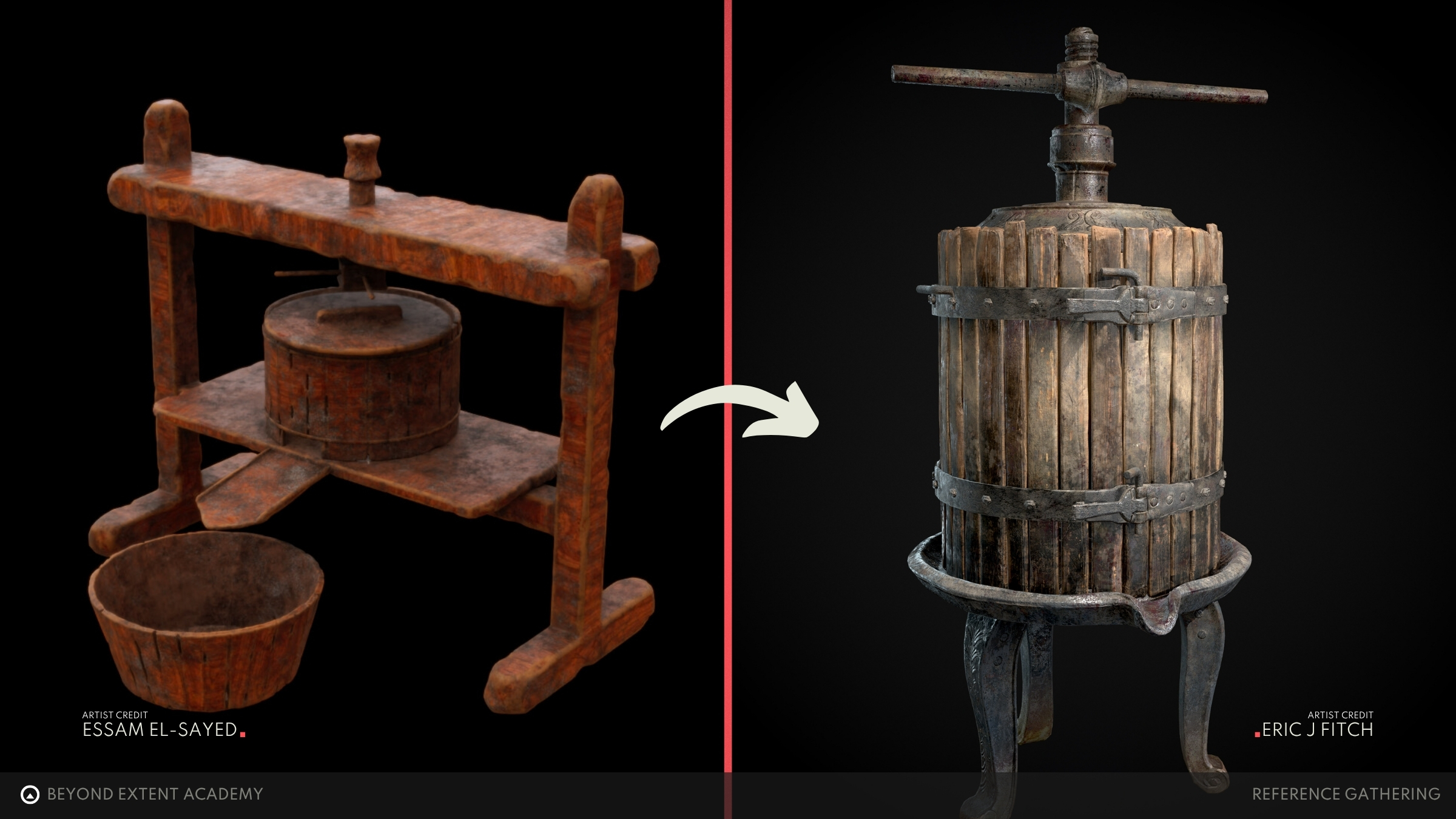
Then once we have build up our visual library by taking more visual in and analyzing them we can then rely more on our internal library rather than external references. Getting to a place where you can do this takes time, so be patient and more importantly, explore and take in more of the world.
VISUAL LIBRARY:
This is made up of all the visual reference you take in over time, the more you pay attention and consciously take in your surrounding the quicker this grows.
Allowing you to reference things from memory with more consistency and require less time spent reference hunting, apart from details.
WHAT MAKES GOOD REFERENCES?
So we know what references allow us to do, however, what makes for a good reference compared to a bad one?
Good references are the ones that fill in the visual gaps we’re missing, allowing us to study and analyse objects more. This then allows us to get a better understanding of the subject being made so that it’s unique features can emphasized.
Since references are all about learning and analyzing the objects or spaces we’re in, getting as close to the real life source of an object, area or place will give you a better understanding and make your creations more believable.
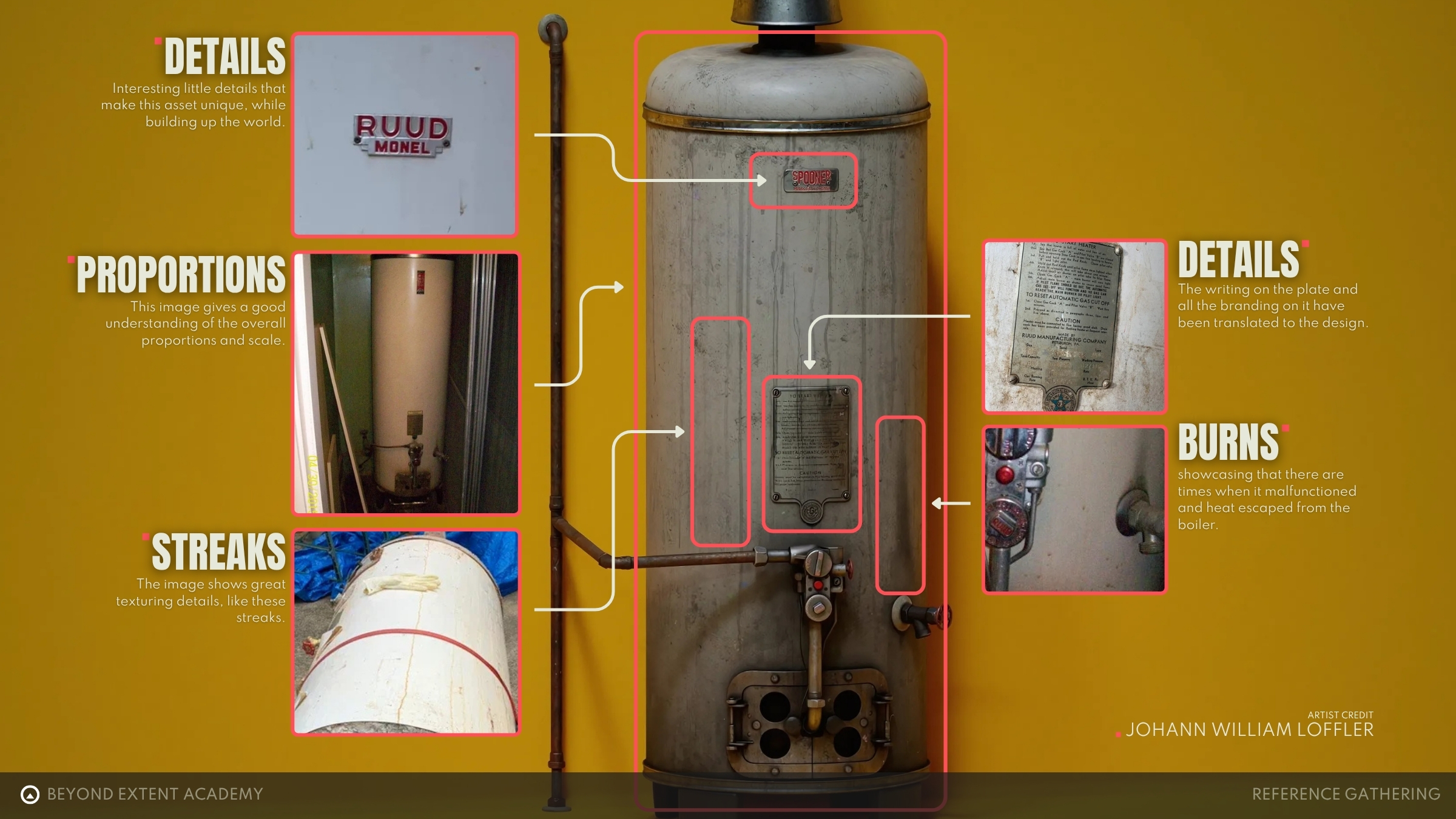
For example, when creation a this water boiler, you might not know how it functions, what the surface looks like or what details make it feel real. Whenever you have questions like these, that’s where references come in to help you.
REFERENCE SOURCES
Let’s look at references from a wide perspective. Search engines give you a good broad understanding of topics you are researching, however, often times we need to get as close to the topic we are researching to get a thorough understanding of what we are trying to recreate. Before we dive into that, let’s start with a broad overview of different reference sources ourself.
- IN PERSON
Best for understanding how it relates to the bigger context, gives you a great sense of scale and proportions. - DEEP RESEARCH
For example, blogs, Auction sites, Historians, Professors, Books, etc… These give you a highly accurate and specific understanding of the topic, but it makes it harder to understanding the actual proportions/details unless they specifically mention or reference them. - SHALLOW RESEARCH
Can help you greatly buy exploring the topic from a broader perspective and allows you to explore the wider context more effectively before diving into things. - FICTIONAL RESEARCH
Could prove useful to give you examples of how other artists have approached things or just to give you initial exposure to a topic before researching it yourself.
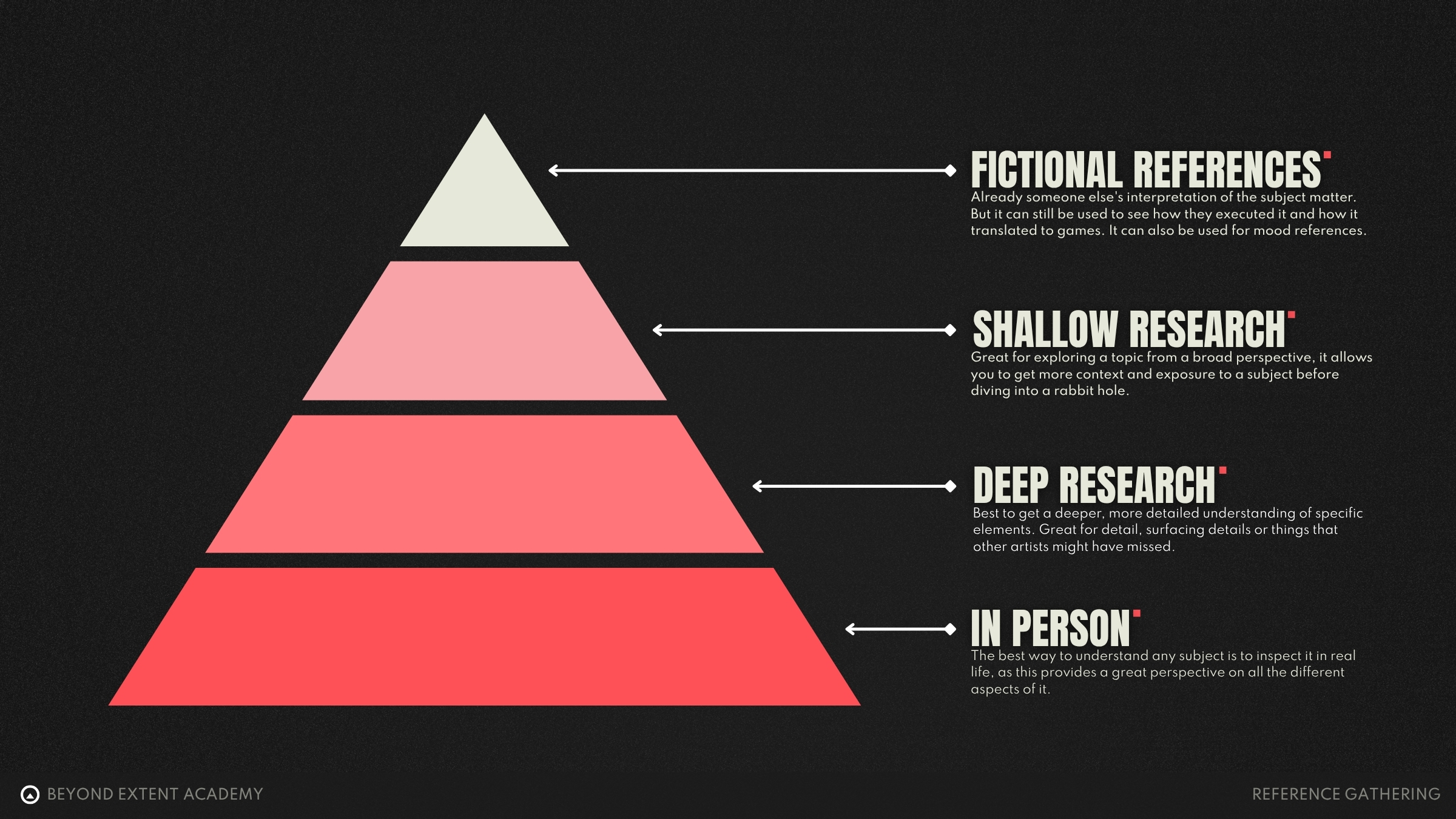
The closer we as artists can get to the source of the item we are trying to create, to more detailed the information and context we need to recreate it becomes. We can then use this information to translate this into functional, believable and immersive items or environments.
REFERENCE GATHERING
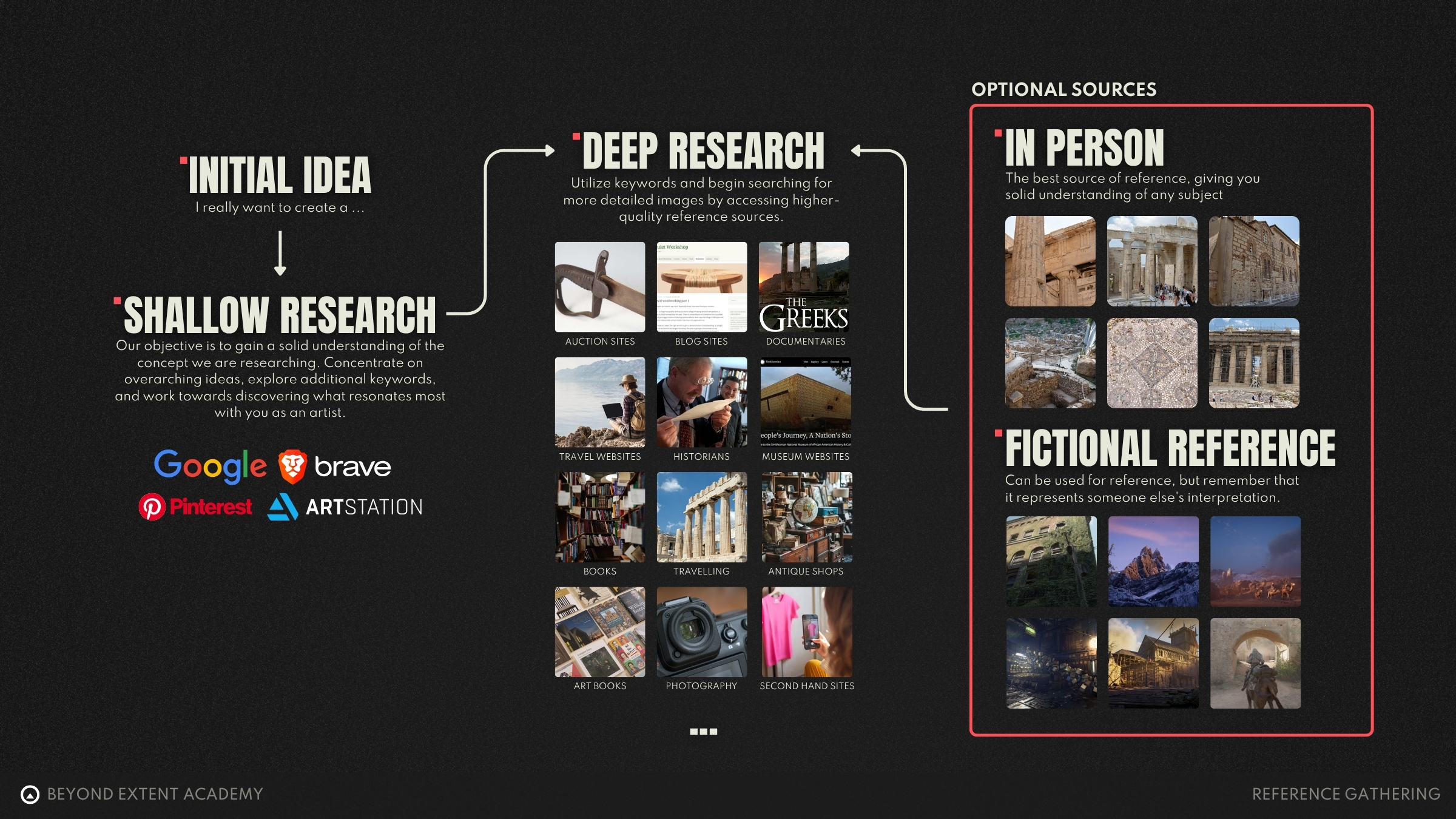
Once you have your idea of what you want to create then it’s time for our research, I’ll share the framework in general terms and then dig more into specific examples as we go along.
We always start by researching at a high level and then go more detailed as we go along.
You’re understanding of any topic is never going to be perfect, and that’s fine, we only really need to gather references for what we need to represent our creations in 3D, so we don’t need to become historians on the topic.
Keep thinking about references as a living document, it’s better to do research when needed, compared to doing so much research and spend so much time on it that you might end up wasting a whole bunch of it.
SHALLOW RESEARCH
We start out with online searching to see what comes up when we type in key words for our project. Giving us a good overview of what comes up visually. It’s always good to try different search engines and a variations of keywords to see which ones give you the best results.
USE SPECIFIC KEYWORDS
“1950’s enamel green celling lamp” is going to give you more specific results compared to “Vintage Hanging Lamp” Same goes for ”1400 Medieval Art” compared to “Medieval Art”. Both terms can be useful when needed, but try to get more specific over time.
While we are in this step, pay attention to your sources, if something feels of, or you feel the source is not trustworthy look into it. When dealing with images try to avoid any stock image sites as it’s hard to tell which images are real or generated at this point. A quick click on the image source will help you find out where it comes from, and even if it’s real or not.
CAREFUL ABOUT YOUR SOURCES
Stock images sites like, pixabay, IstockPhoto or sites with lots of recreations like Etsy, etc… are just some examples of what to avoid. But trust your senses, if it doesn’t look/feel real, better to go for another image instead.
As you spend more time researching, you will also find yourself refining your keywords over time as you hone in closer and closer to your targeted reference. This is way easier to do when it comes to individual assets compared to environments. Related images is a really useful tool in the process here. and can give you some good insights into what can path the follow for deeper research.
DEEP RESEARCH
Once we got a good surface level idea, we can then dig in deeper. Keep on the lookout for visually interesting images on your shallow reference hunt and then dig deeper if you spot something interesting. In this step is usually where the collecting of references really begins, since there are usually higher quality and show more specifically what you are looking for.
When conducting in-depth research, you may discover that some essential details are still missing. That’s when firsthand investigation becomes invaluable. While many topics can be explored sufficiently from a from online research, visiting locations or examining materials in person can set your work apart. If you’re aiming for originality and depth, nothing beats the insight gained from direct experience.
With the framework out of the way, let’s explore some specific examples.
SINGLE ASSET EXAMPLE
First we are going to explore what this looks like on a small asset basis. Following the structure we laid out before, we can now start filling in the flow like this.
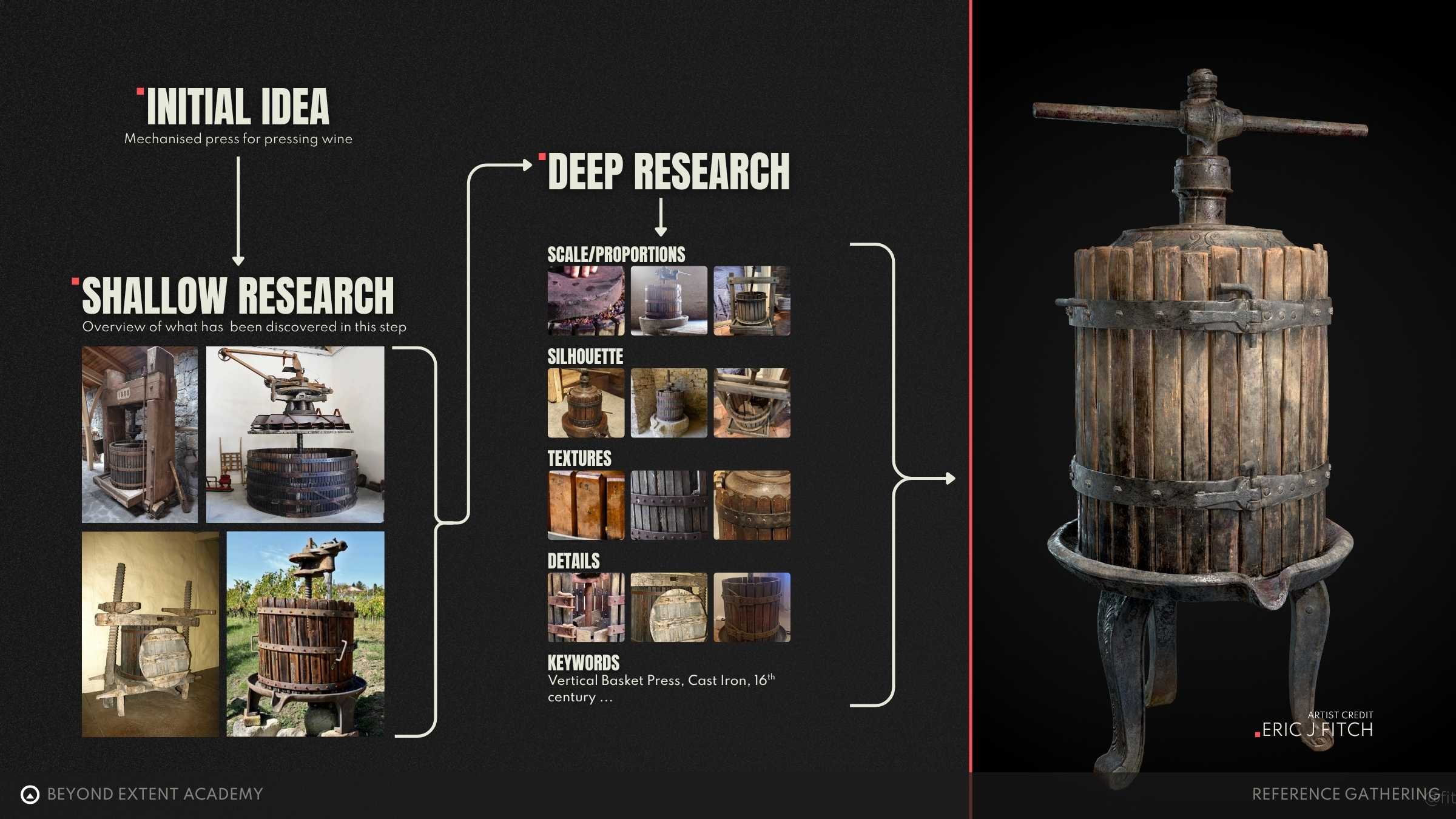
- Scale/Proportions (How it relates to real world scale, or other objects)
- Silhouette (What the shape of the object is, defining features and how it stand out from it’s surroundings)
- Textures (Texturing details, especially handy for when you are at the texturing stage)
- Details (Interesting area’s of the object that can add a unique character or are things that you didn’t notice before)
When looking for references for individual pieces such as props, focus on collecting information about the details, textures, materials, and little extra tidbits, that could make a piece unique and “breathe life into it”. We’re looking for the smaller details.