








to do list (Admin only)
Replace videos with Thumbnail capable video embeds
LESSON OVERVIEW
When we tell stories visually, emotion is everything. It’s what makes an image resonate with the viewer. So many things shape that emotion: the environment, the composition, a characters’ performances. But the one thing that ties all aspects together is lighting. When a sad scene feels cold or a joyful one feels warm, it’s the lighting that provides that emotional context. We’re naturally sensitive to it, we feel when a scene is too cold or too warm for the moment. If the lighting doesn’t match the story, even the best visuals can fall flat.
As artists, it’s important to understand the power that lighting has to change the perception of our creations, and how we can wield it to our advantage. In this lesson, we’ll explore what lighting truly means, what it involves, and the key elements that define it. By the end, you’ll have the foundation to create believable, emotionally resonant lighting in any environment or cinematic, no matter the software or engine you use.
⚠️
Missing LESSON OVERVIEW
The Old Masters
.jpg)
One of the most effective ways to understand how lighting works, and why certain lighting feels pleasing to the eye, is to study the masters who came before us. Artists from the Italian school of the 1700s, such as Caravaggio, and painters from the Hudson River School, exemplify how light can shape a composition. More recently, artists like James Gurney have continued this tradition of lighting mastery.
From them, we learn the art of balancing light and shadow, and how the proper combination of both can create striking images, an approach that continues to inspire modern visual media like games and film.
“Quality over quantity” is the best mentality for lighting. Less is more. We often tend to overcomplicate our process, when in many cases, limiting your choices in color palette and number of lights leads to better, more refined results.
Learning to see the world not just in shapes, but in value, color, light, and shadow will shift your perspective and help you create truly stunning pieces.
Lighting Fundamentals
One of the most common challenges when starting to light a scene is not knowing how to create what we call “dynamic” lighting. The term dynamic refers to lighting that makes an image interesting and easy to read. It’s the opposite of what’s often called “flat” lighting, when images feel dull, lifeless, or fail to evoke emotion.
In this section, we’ll break down the fundamentals into four key, easy-to-digest aspects. Lighting can go much deeper than this, but if you can identify and apply these pillars in your work, you’re already on the right path to creating believable and dynamic lighting.
Shape/Form
In visual terms, shape refers to an object’s two-dimensional outline, whereas form is the volume and dimension created by lighting and shading. Think of shape as what an object is, and form as how light makes it feel three-dimensional.
When thinking about shape and form, we must ask ourselves: “Can we easily read the shape of the object? How does the light define its form, how does it wrap around the object?” In simple terms, shape defines what the object is, while form describes how light interacts with it.
Let’s look at these two pictures:
.jpg)
Ask yourself: which one is more interesting? In both images, we can clearly see that we are looking at clouds. The one on the left, although recognizable, doesn’t tell us much. However, the one on the right tells a completely different story. The interaction of light and shadow creates greater depth and layering, immediately drawing a viewer’s eye towards it, and making the colors in the image feel vivid and engaging.
Let’s have a look at another example!
.jpg)
As with the previous example, the same concept applies. In both images, we can clearly see that we are looking at a forest, but one demonstrates much stronger storytelling and layering. The image on the left represents what we would consider flat lighting, while the one on the right exemplifies dynamic lighting.
If we were to list the elements that help create dynamic and engaging images with strong shape and form, this image serves as an excellent illustration of those principles:
.jpg)
We’ll only scratch the surface, but these are the key elements to keep in mind:
- Diffuse Light: Base value that falls onto an object. Most of the time, this comes from the main source of light. This is the most common form of light we see in everyday life.
- Highlight (Specular Hit): Adds extra interest to the shape and helps the viewer to connect the subject to the source of light. Highlights also reveal the size and direction of the light.
- Cast Shadow: The definition is in the name — a shadow cast by the object onto something else! The direction of shadows defines the main light source and adds believability to a scene. Shadows create separation, layering, and breathing room within an image. One common mistake is trying to light everything evenly — pockets of shadow are necessary to give the viewer space to explore and appreciate the scene.
- Occluded Shadow: The darkest part of the image, typically found where objects meet or in deep corners.
- Indirect Light (Bounce Light): Light that comes from the environment surrounding an object. It is created by the main light reflecting off of surfaces in the scene.
"Just as musicians are always conscious of intervals between notes, artist must be aware of maintaining consistent tonal intervals." James Gurney - Color & Light
Let’s briefly touch on an aspect of indirect light! There’s a common misconception that shadows are inherently black, but this is far from the truth. Shadows, as we typically think of them, are actually the result of bounced, indirect light in the scene. On a sunny day with a clear blue sky, most of a shadow’s color comes from the sky and the light it reflects. Inside a lush, green forest, shadows will take on more of a green hue. Similarly, if you’re next to a bright yellow sign, the indirect light will carry the yellow tonality of that sign.
This concept is a cornerstone of cinematic lighting and lighting in general. All of these elements can be clearly observed in many movie scenes:
.jpg)
.jpg)
Depth
One of the most important aspects of environment lighting is conveying a sense of depth. Depth is the visual sense of distance and space in an image, created by using light, shadow, color, and atmosphere to separate foreground, midground, and background elements.This helps create visual interest between the different planes in an image.
A simple example of this can be seen in landscape photography or cinematic scenes. The farther elements are from the viewer, the more the atmosphere affects them, causing them to gradually lose saturation and contrast with distance. This is called atmospheric perspective!
.jpg)
This is why it’s essential to study real-world references and understand how light and atmosphere interact before building your lighting setup.
The concept of depth naturally leads us to our next topic: contrast and separation!
Contrast & Separation
- Contrast is the difference between light and dark areas that creates visual impact and guides the viewer’s eye.
- Separation is the use of light, color, and value to clearly distinguish objects and layers within a scene.
When planning lighting for environments, it’s important to remember that the human eye is naturally drawn to areas where the brightest pixels contrast with the darkest ones. This helps ensure that our focal point receives the attention it deserves and that we establish a clear visual hierarchy within the scene.
.jpg)
If we take a close look at the foreground and background in these paintings by Albert Bierstadt, we can see that the level of contrast between elements decreases as they recede into the distance. Greyscale emhasizes the gradiation.
The values present in the foreground are much more distinct. The range between the darkest blacks and brightest whites is stronger, while in the background, those values start to blend together.
This principle is widely used in movies and TV shows. Filmmakers apply contrast intentionally to guide the viewer’s attention exactly where they want it. A great example of this is Arcane Season 1, which is a masterclass in using contrast to achieve clear visibility and strong visual readability.
.jpg)
- In Windows, you can enable a shortcut to view your screen in greyscale. Search for “Colour filters” in the settings, and you’ll be able to toggle between color and greyscale mode.
Light on Dark & Dark on Light
Light over dark and dark over light refer to placing brighter elements on a darker background or darker elements on a lighter background to create contrast, visual hierarchy, and depth within a composition.
It’s a simple idea, but a powerful tool to have at any artist’s disposal. This principle appears time and time again in cinematography. This type of layering guides the eye and clarifies the composition, making the image more readable.
.jpg)
One key thing to remember about lighting and color is that shadows and light have a natural pattern. Light generally moves toward cooler, desaturated tones, while shadows get richer and warmer as they deepen. The next video will show this principle in action.
Types of Lights & Inverse Square Falloff
Now that we have a better understanding of the components of lights, we will start laying down the foundation on the different tools and mechanisms we have to light a 3D space.
Inverse Square Falloff
Before discussing what types of lights we have, it’s important to understand how lights work. This is where the Inverse Square Falloff comes in.
.jpg)
The inverse square law is a mathematical principle that explains how light intensity decreases with distance. In simpler terms, it describes how light grows dimmer as you move farther from the source. Think of a candle in a room: the closer you get, the brighter it appears, and the further away you move, the dimmer the light becomes. This concept is crucial when setting light radius and intensity in 3D software.
Types of Light
There are two types of lights: Natural and Artificial (or “practical”).
Key natural light sources include:
- Sunlight
- Moonlight
- Sky (light bounced from the atmosphere)
- Fire (only natural sources)
Let’s dive into what these are!
Sunlight
- Sunrise
- Morning/Afternoon
- Sunset (also called Golden Hour)
- Moonlight
.jpg)
Contrary to sunlit scenes, moonlit scenes are exclusive to night time.
We often can forget how dark night is in reality. Without direct natural light, in this case moonlight, an environment lacks visual context, as any detail outside of the range of direct, artificial lighting gets swallowed by darkness.
.jpg)
Nighttime lighting can be especially difficult to plan for, making careful reference gathering vital. Moonlit scenes, or nighttime scenes, must be made in very particular ways due to how we as humans perceive night.
.jpg)
Understanding the style and mood of a natural scene is key to drawing a viewer into a scene without breaking believability and storytelling.
Sky Lit Scenes
The main characteristic of a primarily sky-lit scene is the lack of strong shadow direction. Light is distributed evenly across the space. For example, in an overcast environment with heavy cloud cover, sunlight diffuses, creating uniform illumination. The same principle applies indoors when no direct sunlight enters a room—most of the lighting comes from the bounce of sky and surrounding surfaces.
This topic can get quite complex, but to scratch the surface, these are some typical examples of primarily sky-lit scenes:
.jpg)
The main component that defines a primarily sky-lit scene is the lack of shadow direction. Everything is lit evenly. Think of an overcast day where there’s a lot of clouds, the light diffuses itself to the point where the light is distributed evenly across the space. The same applies as when you are inside your own home but no direct sun is hitting the room, most of the room is lit by the bounce of the sky and the surroundings.
Practical/Artificial Lights
In contrast to natural lights, artificial lights are all sources created by humans. Think of lamps, lanterns, candles, or campfires — anything not caused by natural phenomena.
.jpg)
Lighting Actors in Unreal Engine
It’s important to note that while these examples are shown in Unreal Engine, other game engines such as Unity or CryEngine use the same underlying principles, even if they have different names for lighting actors. Remember, the engine doesn’t define your value as an artist. As long as you make thoughtful decisions with the tools available, you can get amazing results regardless of the engine or software you use.
Our toolkit includes several types of lights, which can be divided into two categories:
- Local lights (e.g., Spot, Point, Rect)
- Natural lights (e.g., Skylight, Directional Light)
All of these lights can be accessed in the ‘’Place Actor’’ menu.
.jpg)
Local Lights
Local lights are comprised of the following types of lights:
.jpg)
- Point lights are lights that cast light and shadows (if enabled) in a 360-degree radius. They are generally more “expensive”, meaning they require more processing power than other types of lights.
- Spot Lights cast light and shadow in a single direction, depending on the size of the cone angle. In Unreal, you can control this with the Outer Cone Angle and Inner Cone Angle settings. Spot Lights are generally the most performance-efficient (“cheapest”) lights to use.
- Rect Lights are considered area lights because they cover a larger surface. They are especially useful for simulating rectangular shapes such as softboxes, windows, or TV screens. Notice in the video how increasing the size of the light source softens shadows and changes the reflections on the floor.
Natural Lights
Natural lights are those that do not have a defined range, such as the sun.
- Directional Light is one of the main light sources in Unreal Engine, particularly for exterior scenes. Because it has no defined range, it is affected primarily by rotation rather than the location of the actor.
- Skylight controls the indirect, soft light coming from the sky (or from an HDRI, for example).
- Each of these lights has different parameters that are worth experimenting with to understand how they respond in various situations.
Each of these lights has different parameters that are worth experimenting with to understand how they respond in various situations.
Importance of Fog
After a sky/skylight is set up, sun direction and intensity is decided upon, and exposure levels are configured, it’s important to consider adding more depth. One of the key elements to include in an environment is some form of atmospheric effect, such as fog. This helps separate elements and adds depth to a scene. In Unreal Engine, this can be achieved using Exponential Height Fog. It’s highly recommended to read it’s documentation to understand its properties.
.jpg)
Let’s take a look at a quick example. At this stage, the sun and shadow directions are set, and everything is in place to start guiding the viewer’s eye. However, at the moment, all elements in the environment carry the same visual weight. There’s little layering in the image since most elements share similar values. Adding atmospheric effects changes this.
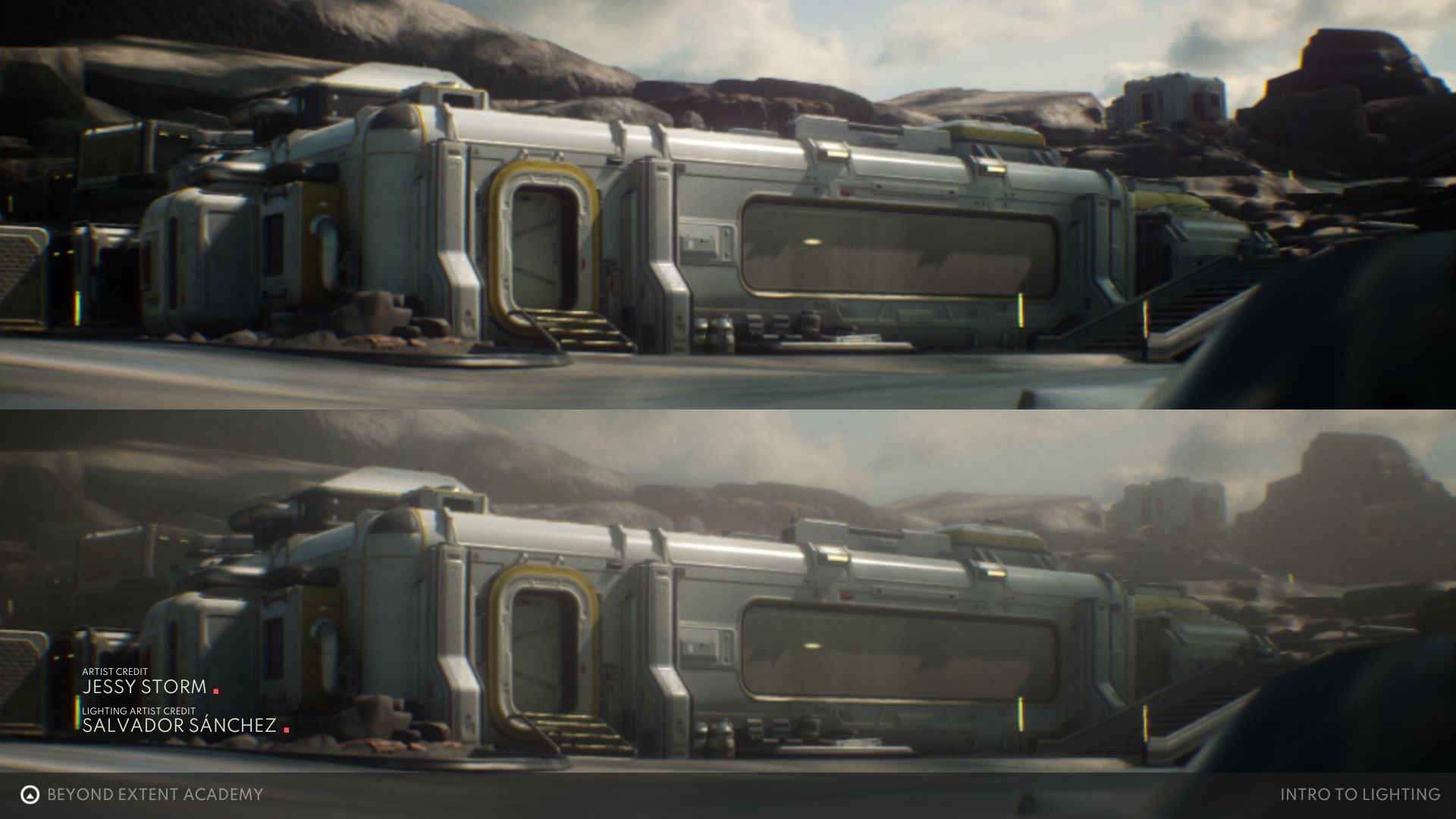
There is now a clearer distinction between the foreground and background. This also helps the environment feel more alive and natural. Keep in mind that the farther an object is, the more it is affected by atmospheric effects.
Lighting Units & Color Temperature
One of the key components for creating believable lighting is the correct use of light units and intensities. There are three main units used to measure light intensity in both the real world and 3D space:
- Lux measures the intensity of sunlight or moonlight.
- Candela is primarily used for fire-based sources.
- Lumens measure the intensity of practical lights such as fluorescent lights, lamps, and lamp posts.
.jpg)
It’s good practice to use real-world light values. Whether your project is stylized or realistic, applying these principles ensures consistency across your lighting setup and maintains balanced contrast between light sources.
The following image serves as a cheat sheet, showing different color temperatures and light intensities based on real-world measurements.
.jpg)
It’s very important to keep in mind that These are guidelines, not strict rules. Use them to establish a strong foundation for your projects, and adjust as needed based on artistic direction or style!
Common Lighting Techniques
There’s a multitude of lighting techniques for both characters & environments. Here, we’ll focus on the most common ones to build a solid foundation.
3/4 & Rembrandt Lighting
A staple of Hollywood cinema, this lighting technique can be found in nearly every modern film.
Originating from painter Rembrandt Harmenszoon van Rijn, this style uses a triangle of light on the shadowed side of the face to add depth and define facial features. This approach created a pleasing gradient of light and shadow, emphasizing the natural features and depth of the subject’s face. When you start analyzing frames from various films, you’ll notice this technique being used time and time again.
.jpg)
Frontal Lighting
Often avoided for the flatness it can create, frontal lighting contrasts with dynamic lighting styles. Though uncommon, when paired with the right composition, it can be highly effective with unique results. Let’s explore a few examples:
.jpg)
Back-lit Lighting
Another staple of Hollywood lighting, backlit lighting naturally separates the subject from the background, making it a valuable lighting technique to incorporate into scenes. Many films use this approach, but one that demonstrates it masterfully is Pride and Prejudice.
.jpg)
The camera is placed in front of the light source. This allows the subject to be Rim Lit by the main light, naturally separating them from the background.
None of these effects would be possible without proper camera exposure. Let’s take a closer look at how this works.
What is Exposure?
In photography, exposure refers to the total amount of light that reaches a camera’s sensor or film, determining the brightness of the resulting image. It’s important to note that light intensities are not adjusted for exposure. Instead, you first set the light intensities and then adjust the exposure accordingly.
A common pitfall is adjusting light intensities after the exposure is set. Doing so can break the consistency of the scene and result in unrealistic lighting.
.jpg)
As this example shows, properly controlling exposure is key to creating images that are easy to read and pleasant to look at. The sun doesn’t change between these shots — what changes is how the camera or phone adjusts exposure for that particular moment.
In Unreal Engine, exposure settings can be found in the Post Process Volume actor, which looks like this:
.jpg)
While this only scratches the surface of proper exposure, start by setting accurate light intensities and appropriate Min and Max exposure levels. Use Exposure Compensation to achieve the desired look. If you’re aiming for a specific time of day or weather condition, refer back to the cheat sheet above to experiment with EV100 values.
Conclusion
Progress in lighting always starts with a strong grasp of the fundamentals: seeing value, contrast, and how light interacts with the world. With a solid understanding of these basics, you’ll be able to make effective lighting decisions in any engine or tool you choose.
In practical terms, less is more. Keep your number of lights to a minimum, and set their intensities using physically based values whenever possible. This will give your scene consistency and a believable relationship between all your light sources.
Once your light intensities are set, use exposure to shape the mood of the scene.
Good luck and happy lighting!
RESOURCES
⚠️
MISSING RESOURCES